Blog vs Substack: Which One Actually Builds Your Business?
Filed Under


“Should I start a Substack?” I cannot tell you how many times I have gotten this question in the last six months. From clients on Zoom calls. From women in entrepreneurship communities like CEO Besties. From people who slide into my DMs after a podcast episode with a quick question about whether Substack is the move.
And almost every single time, when I ask what they currently have for long-form content, the answer is the same. They do not have a blog. Or they have a blog and no idea if it is getting traffic. Or they have a handful of random posts with no strategy connecting them.
But they want to start a Substack.
If you have been weighing blog vs Substack for your own business, this post is going to walk you through when each one actually makes sense, why Substack works for someone like Jenna Kutcher but not for most of the entrepreneurs I talk to, and three things that have to be different about blogging in the age of AI if you want to see results.
88 \ Why Substack Is Not the Answer (Blog vs Substack in 2026)
Why Everyone Is Suddenly Asking About Substack
For the last year, Instagram has felt like a part-time job that pays nothing. You post, you spend the time, you do the trends, you write the captions. You even train AI to sound like you so you can write captions faster. (I outsource mine to a VA, and even then, the reach just is not there.) Seven people see your reel and three of them are your mom, your sister, and the woman who sat next to you in tenth grade biology.
So everyone is asking the same question in different ways. Where should I be putting my energy? Is Instagram even worth it anymore? Where are people actually paying attention? And Substack walked into that conversation at exactly the right time.
I get the appeal. You write long-form. Your readers get your content in their inbox. There is a built-in recommendation engine. People are growing real audiences over there. Even as I am writing this, part of me thinks, “Why don’t I do this?”
I will tell you why.
Substack is still someone else’s platform. You do not own the rules, the algorithm, the discovery, or the future of how your content gets distributed. It is, in a lot of ways, just Instagram with longer captions and a less obnoxious algorithm.
If your entire content strategy is renting space on someone else’s platform, you are going to be having this exact same conversation in two years when Substack changes how recommendations work, or shifts their pricing model, or something newer and shinier comes along. That is just the cycle.
The thing that fixes the “shouting into the void” feeling is not picking a different platform to shout from. It is building a place that is actually yours. For 90% of you reading this, that place is going to be a blog.
Why Substack Works for Jenna Kutcher (And Why That Is a Misleading Example)
If you know Jenna Kutcher or someone like Amy Porterfield, you might be thinking, “Well, Jenna is doing it. Jenna moved to Substack. If she is doing it, it must be the move.”
I love Jenna. I have followed her for years. She is one of the best content marketers in this space and she generally makes strategic moves. But here is what most people miss when they look at her Substack and think, “I should do that too.”
She has been blogging consistently for over 10 years.
We are talking weekly, sometimes more, for over a decade. That kind of consistency creates a foundation of search traffic that just keeps working in the background. Every single day, people are finding her old blog posts through Google. That foundation does not go away when she opens a Substack. It is still there. Still doing the work.
She is still blogging weekly.
I actually went and looked at her site recently. Jenna is publishing SEO-optimized posts on her blog every week, even with the Substack going. She did not abandon the blog. She did not replace the blog. She added Substack on top.
Her Substack content is completely different from her blog.
Her Substack is personal. It is about gardening, Minnesota life, the stuff she does not want on her business website. Her blog is still her SEO and business engine. She is not duplicating content (which is a huge mistake by the way, because if you do start a Substack and just repost your blog there, you will be competing against yourself for organic traffic).
She was already getting at least 8,500 organic visitors a month from Google before she ever opened a Substack.
That is the engine running behind the scenes. Real search traffic from real people typing questions and finding her content. She did not grow on Substack first and then build a blog. She built the blog for a decade, and then layered Substack on top.
So when you look at Jenna and think, “I should do what she is doing,” what you actually need to do is what she did for 10 years before the Substack ever existed. Build the owned foundation first. Then add channels on top. Copying just the top of someone’s content stack without copying the base is how you end up with a Substack and no traffic. That is the miss.
Why Substack Is a Trap for Most Entrepreneurs
Almost every entrepreneur asking me about Substack has zero long-form content they actually own. No blog. Or a blog that has not been touched in two years. Or three random posts they wrote when they launched their business and never added to.
Here is the part I want to be honest about. Nothing says “I want to own my audience” like moving to another platform you do not own. We are escaping one algorithm to go to a different algorithm. We are fixing a platform problem with more platforms. That is not the level up we think it is.
If you are not willing to write consistent long-form content on your own website, you are not going to write it consistently on Substack either. The discipline is the same. The blank page is just as blank. The only difference is which platform owns the audience and the data.
On your own site, you own everything. SEO traffic. Email captures. Analytics. URLs. The future of that content. If you decide to redesign your site or pivot your business, your content moves with you because it is yours.
On Substack, you have an email list you can technically export, sure. But you do not own the discoverability. You do not own the recommendation engine. You do not own how Substack chooses to evolve. You are still renting.
If you have a podcast and you are thinking, “I will just put my show notes on Substack,” fine. But put a blog correlating to your podcast on your own site too. Do not save the good stuff for Substack and leave your website starving.
Substack is not the shortcut around the real work. It is the same work in a different uniform.
Is Blogging Dead in 2026?
You are going to hear people say blogging is dead because of AI. They are wrong. Blogging absolutely still works. Long-form content on your own site is still one of the strongest plays you can make as a small business owner. SEO is not dead. Blogging is not dead.
But you cannot blog the way people were blogging in 2018. If you are still cranking out generic 800-word posts stuffed with the same keyword four times (or worse, having AI write them with zero personality), it is not going to move the needle.
Here are three things that have to be different about blogging in the age of AI.

3 Things That Have to Be Different About Blogging in the Age of AI
1. Write for Questions, Not Just Keywords
The way people find content has shifted. ChatGPT, Perplexity, and Google’s AI Overviews all pull answers from content that clearly answers specific questions. Google’s own documentation on AI features in Search confirms that the same SEO fundamentals apply, with pages needing to be properly indexed and structured to be eligible to appear.
So your H2 headers should be actual questions your audience would type or speak into a search bar. Not “Important SEO Tips.” Nobody is searching for that – but you know, that would make my life easier.
But “How do I get my small business website to show up on Google?” That is a real question a real person is asking. AI tools pull answers from content structured that way.
And here is the kicker. The answer to that question should come in the first sentence or two after the header. Not buried at the end. Not after three paragraphs of setup. AI engines need to grab the answer quickly. Lead with the answer, then expand.
One other thing worth knowing: recent research from Muck Rack on how Claude cites media found that Claude has a “citation sweet spot” in roughly the past 10 weeks. If you are not publishing fresh long-form content on your own site, you are not even eligible to be cited. And if Claude or ChatGPT is citing your Substack post instead of your website, guess what? Substack gets the authority bump. Not you.
2. Lead With Your Story, Your Clients, and Your Real Experience
This is the shift I am most fired up about. AI can write a generic blog post in 30 seconds. I have literally had clients show me blog services that do exactly that. Generic content is dead. The internet is flooded with regurgitated “10 tips for whatever” posts. None of them rank. None of them get pulled into AI answers. None of them convert anyone.
What AI cannot do is be you.
I recently worked with a home organizer in Arizona who wanted to rank for organizing services in Sedona. Instead of writing a generic “tips for organizing your closet” post, I had her pull in a real client project she had done in Sedona. She used her targeted keywords. She talked about that specific client. She named the products she actually used. That post does what generic AI content cannot do. It ties real expertise to a specific place and a specific story.
The blogs winning in 2026 are personality-led and expertise-led. Real voice. Real stories. Specific opinions. The more specifically yours your content is, the more it stands out.
Bonus: that kind of writing gives you the personality and warmth you might have been looking for in a Substack. You do not have to start a Substack to write with personality. You can do it on your own blog, on a URL you own, and earn SEO traffic at the same time.
3. How to Build Topical Authority on Your Site
Topical authority matters more than ever. Google and AI search engines both reward sites they recognize as a clear, reliable source for a specific subject. Major SEO publications like Search Engine Land’s guide on topical authority have called it one of the strongest on-page ranking signals out there now.
If you are wondering how to build topical authority on your site, the answer is to go deep on fewer topics, not wide on everything.
Pick three to five core topics that connect to what you actually sell. Write a long, comprehensive pillar post on each one. Then write supporting posts that link back to the pillar.
For me, my lane is SEO, web design, and Pinterest. All of it ladders up to organic marketing for small business owners. That clear focus is part of why my blog ranks for what it ranks for. Google has figured out what my site is about. If I was going to niche even further, I would focus on SEO for wellness brands, since most of my Minnesota clients fall into that category. The narrower you go, the easier it is to become the obvious source.
Instead of one post on Pinterest, one on email marketing, one on Instagram Reels, and one on your dog’s birthday party, pick a lane and own it. One focused, well-researched post per week (or even per month) beats four scattered posts every time. Consistency on a clear topic beats volume on random topics.
If you want more on this, I have a whole SEO tips section on my site that walks through what is working in 2026.
When a Substack Actually Makes Sense
I am not anti-Substack. I want to be clear about that. I just want people making this decision with their eyes open. Here is when a Substack actually makes sense.
1. You already have an established blog generating traffic.
Your SEO foundation is working. Your content engine is running. You have proof that long-form content is doing something for your business. Substack becomes an add-on, not a replacement.
2. You want a personal-life layer that does not fit on your business website.
Like Jenna. Maybe you want to write about parenting, life outside of business, corporate life, mental health, or anything else that does not belong on the SEO side of your brand. Substack is built for personal essay and reflection. It is a great home for that kind of writing, and keeping it separate from your business site protects your Google authority on your core topics.
3. You have the capacity to add a channel without dropping the work that is actually driving results.
This is the big one. If you are barely keeping up with what you have now, do not add Substack. You will half-do both and end up frustrated with both. And do not duplicate your blog content on Substack. Ever. You will compete against yourself for organic traffic.
If your blog is dusty, your SEO strategy is non-existent, or you are using Substack to avoid the harder work of long-form content on your own site, Substack is not the answer. The blog is the answer. You just have not started yet. Order matters. Own first, then add.
Blog vs Substack FAQ
Is blogging dead in 2026?
No. Blogging is not dead. The strategy just has to be different. Generic, keyword-stuffed posts are dead, but personality-led, expertise-led blogs that answer real questions and build topical authority on a focused subject are still one of the strongest organic traffic plays a small business owner can make.
Should I start a Substack or a blog?
If you do not already have a blog with an SEO strategy and consistent traffic, start with a blog. A blog is owned, builds long-term authority, and shows up in Google and AI search. Start a Substack only after your blog is working, and only if you have a clear, separate purpose for it (like personal essays or behind-the-scenes content).
Can I just put my blog content on Substack?
Please do not. If you publish the same content in both places, you will be competing against yourself for organic search traffic, and Substack will probably win because of its built-in recommendation engine. If you do both, the content needs to be materially different.
What if I have a podcast? Should my show notes go on Substack?
Your show notes belong on your own blog as full SEO-optimized posts tied to each episode. That is how your podcast pulls double duty: audio for your audience, written content for search. If you also want to do Substack, treat it as something separate from your show notes, not a replacement.
How long does it take blogging to actually work?
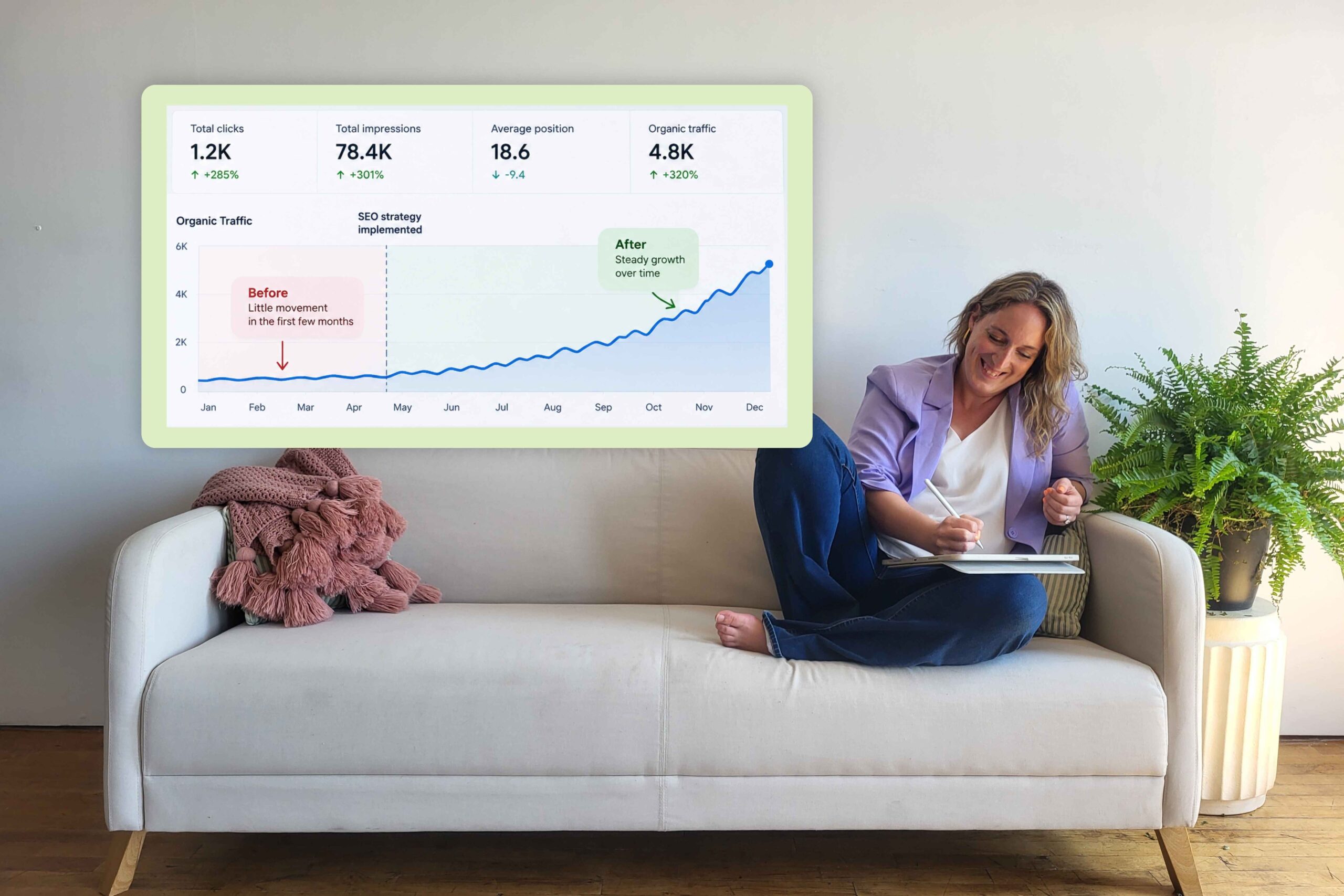
Realistically, 6 to 12 months of consistent publishing on a focused topic before you start seeing meaningful organic traffic. That is why most entrepreneurs quit before it works, and why people like Jenna who stuck with it for 10+ years are the ones benefiting now. Consistency on a clear topic compounds.
The Bottom Line on Blog vs Substack
The biggest thing I want you to take from this is that order matters. Own first, then add. It is not about chasing whatever platform feels new and exciting (although I do kind of love Threads, but that is a different conversation). It is about building a foundation that you actually control. On a site that is yours. With content that does not disappear when an algorithm changes or a platform pivots.
For most of you, that foundation is going to be a blog. A real blog. On your own website. With a real SEO strategy. Written in your own voice on topics you actually know. Structured for how people search now, both on Google and in AI tools. That is the work. It is not as glamorous as opening a Substack and feeling like you started something new. But it is the work that pays you back year after year.
If you want help figuring out if what you are doing is even working, grab my free SEO Monitoring Tools Guide. It walks you through how to set up Google Search Console and Google Analytics so you can actually see your blog traffic.
If you would rather have me handle the strategy, you can check out my SEO services here. And if you are ready to learn SEO on your own and run it yourself, SEO on Tap is the self-guided course from Duo Collective, my SEO mentors. Use my affiliate code JULIEW for $50 off.