What Google’s AI Content Policy Actually Says About Your Content
Filed Under


Two things happened this summer that looked like they canceled each other out. Google published guidance saying it does not care whether your content is written by a human or generated with AI. Then Anthropic, the company behind Claude, started adding invisible watermarks to everything Claude writes.
So which is it? Is AI content fine, or is it about to get flagged? I read both source documents so you do not have to guess where AI generated content and SEO actually stand together right now. In this post, I am walking through what Google’s AI content policy actually says, why your traffic might have dipped over the summer even while your rankings held steady, and how I use AI in client work in a way that still ranks.
What Google’s AI Content Policy Actually Says About Using AI
Here is the part everyone quotes. Google’s guidance says generative AI is useful for researching a topic and adding structure to original content. Notice that word, original. AI is the structure. It is not your strategy.
Here is the part almost nobody talks about. That same guidance says using AI tools to generate a lot of pages without adding value for users may violate Google’s spam policy on scaled content abuse. That line is the actual rule, and I want you to remember it.
Scaled Content Abuse Is the Real Rule, Not “No AI”
Scaled content abuse is not an AI rule. It applies no matter how the content was made. People have been mass producing junk blog posts since long before any of us had a chatbot.
Google is judging the outcome, not the method. That Google page points to two specific sections in the search quality rater guidelines. Section 4.6.5 covers scaled content abuse. Section 4.6.6 covers main content made with little effort, little originality, and little added value.
One fair warning if you go read those sections yourself. Google is clear that rater scores do not directly influence rankings. So do not let anyone sell you a checklist based on the rater guidelines. Treat it as your guiding light for how you generate content, not a scorecard.
What Are Google AI Overviews Doing to Your Click Through Rate?
Here is where a lot of business owners get it wrong. They see traffic fall and assume they got hit by a core update for using AI. In most cases, that is not what happened.
Pew Research tracked real browsing data from 900 US adults and found that people click a traditional search result 8 percent of the time when an AI overview is present, compared to 15 percent when it is not. That is roughly half.
Ahrefs found a 58 percent lower click through rate on the top ranking page for keywords that trigger an AI overview. Seer Interactive has the longest running data set and tracked organic click through rate sliding from 1.76 percent down to 0.61 percent, with some signs of leveling off in 2026.
So your click through rate is down. That is true whether your content is SEO optimized or not. However, showing up in an AI overview still builds authority, even if that visit does not show up as a click. If you are only watching your position on Google, everything might look fine while your inbox goes quiet.
There is also a competitive piece to this. Multiple 2026 analyses point to the same conclusion. When a page loses rankings after a core update, it is often because a competing page got better, not because your own page got worse. That is why SEO is never a one time project. Somebody else updates their page, does more, and you lose traffic even if you did not do anything wrong.
That is exactly why I built my SEO Monitoring Tools Guide. It walks you through how to read your Google Search Console and Analytics data so you can actually tell what is happening instead of guessing.
Does Anthropic’s Claude Watermark Change Anything?
On August 11, Anthropic published a help center article called “How Claude Marks AI Generated Content.” Here is what it says. For Claude models launched on or after August 2, the text Claude generates carries an invisible watermark. It is applied at the model level, so it shows up no matter which Claude product the text came from.
For supported file types like SVG, PNG, and JPEG, Claude also attaches digitally signed provenance metadata using the C2PA standard, an industry framework for recording where digital content came from.
Here is where the nuance matters. A watermark proves the text was processed by Claude. It does not prove a human did not shape it, edit it, or write the substance behind it. Those are two very different claims, and people are already mixing them up.
As of this recording, Anthropic has not yet published the technical documentation on how outside parties can detect the watermark. Right now there is a mark on the content, and nobody outside Anthropic can actually read it.
So what does this mean for you? It is not a Google penalty. Google is not doing the watermarking, and Google has not said anything about using watermarks as a ranking signal. But it does mean the era of quietly passing off raw AI output as your own thinking has a shelf life. You still need to share your story, even if Claude helps you say it.
How I Actually Use AI Content and SEO Together in Client Work
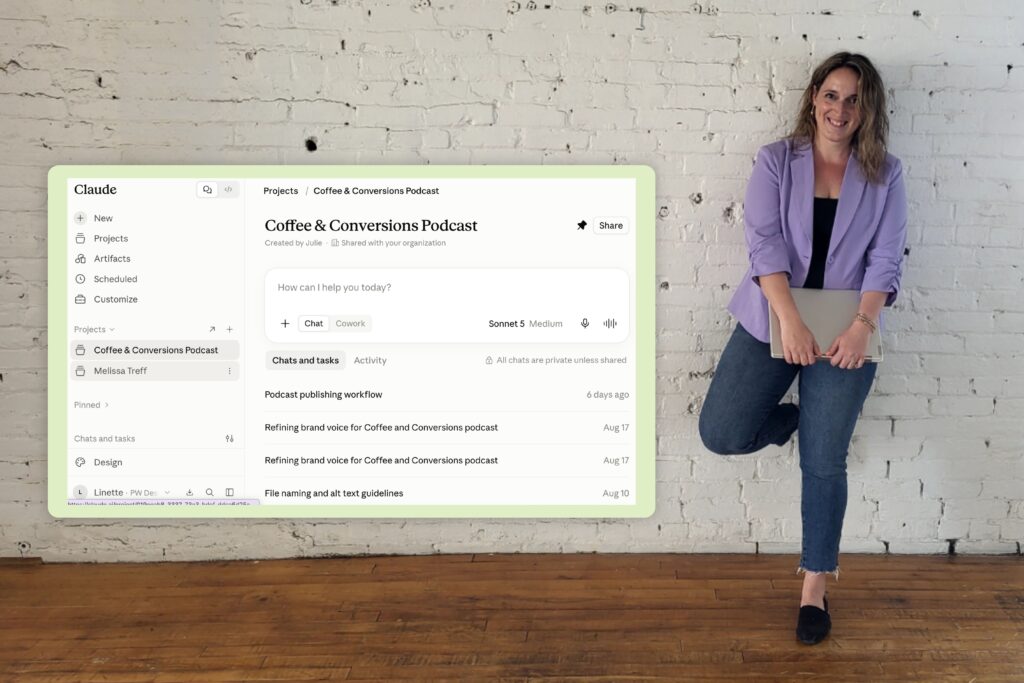
I use AI in client work, and I am not quiet about it. I am also not a hundred percent a writer myself. I go through the real stories with my clients, and then I have Claude help structure it.
How I use Claude is the entire difference between content that ranks and content that gets swept into the scaled content problem.
Take my client How2Mom. She is a doula on retainer with me for a couple of years now. If you pulled up her Google Search Console, you would see a flat traffic line and assume nothing changed in two and a half years. That graph is hiding something big.
Two or three years ago, most of her traffic came from one blog post about a ten year old birthday party that went viral. It had nothing to do with her core business. Her audience is pre-pregnancy through postpartum, not birthday party planners. So we diversified. Every new post now ties back to her podcast and gets researched for SEO, all within her actual niche. One of her top five posts now is about postpartum snacks to eat at the hospital, an actual niche topic that speaks to her real audience.
Here is our workflow. She and her co-host record their podcast episodes about whatever they actually want to talk about. We take that transcript and run keyword research off of it to find a primary keyword. The keyword comes from what they actually said, not from what I guessed the episode would be about.
Then I load that transcript into a Claude project built specifically for her, with her brand voice, her keywords, and a blog skill with my rules baked in. AI drafts the blog from the transcript, so the words are actually hers, not AI making things up. We fold in the SEO fundamentals: primary keyword, FAQs where they make sense, and internal and external links.
AI never invents the substance. It structures what she already said out loud. That is the difference between drafting from a transcript and generating content from nothing, and it is exactly the kind of AI SEO strategy Google is asking for.
What I Track Instead of Just Clicks
I am still tracking clicks. I want to be clear about that. But I stopped reading a click drop as an automatic failure, because it is genuinely hard to get clicks right now.
One of my SEO retainer clients has not seen her number of clicks go up this year. But showing up consistently with quality content has kept her clicks level. In this version of Google, holding steady at a thousand clicks a month is just as good as growing used to be.
If your impressions are holding steady and your clicks are down, it usually means AI overviews are answering the question right there on the results page. That can actually be a good thing. You are still potentially building authority by showing up in those overviews.
The other metric I care about is how many keywords a client’s site ranks for, as part of their broader AI SEO strategy. That number shows whether you are actually diversifying, or leaning on one lucky post that happens to be doing well. Stephanie’s flat traffic line never would have told me that on its own. The diversification and the keyword spread, plus the real inquiries that come with it, are what actually matter.
What I Would Change and What I Would Not
Here is what I would not change. Draft from real recorded conversations or real answers to real questions. If you are a podcaster, draft from your podcast. Do not just tell Claude what your episode is about. Give it the actual transcript.
If you are not recording a podcast, have your clients answer questions directly, because you cannot fake lived experience. AI could write a hundred blog posts a month, but that content gets flagged by Google fast because it is not what the audience is actually looking for, and it is not their real words.
Here is the short version. Google does not care whether you use AI. It cares whether what you published was worth publishing in the first place. Anthropic’s watermarking does not change that math. It just might make it a little harder to hide a shortcut if you were not putting in the work anyway.
Frequently Asked Questions
No. Google’s guidance says it does not care how content is generated. It cares whether AI is used to publish a lot of pages without adding real value, which falls under its scaled content abuse policy.
They are lowering click through rates across the board. Multiple studies show click rates dropping by roughly half to over 60 percent on queries where an AI overview appears, even when your rankings have not changed.
Not directly. The watermark is Anthropic’s own system for marking Claude generated text. Google has not said it uses watermarking as a ranking signal, and the two systems are unrelated.
It comes down to whether the content adds real value for your reader. Content drafted from a real transcript, a real client story, or a real answer to a real question meets Google’s bar. Content that is generated to fill pages without substance does not.
Watch impressions versus clicks in Search Console, and track how many keywords your site ranks for over time. Both tell you more about real growth than a single traffic line does.
You may not be being punished for using AI, but time will tell
If your traffic dipped this summer, do not panic and assume you got hit for using AI. Go look at impressions versus clicks first, then check how many keywords you are ranking for and whether that number has shifted.
If terms like impressions, clicks, and Search Console still feel like a foreign language, that is exactly what my SEO Monitoring Tools Guide is for. It walks you through connecting and reading your Google data so you can actually tell if your site is performing, without needing to become an SEO expert. You can also grab my One Page SEO Checklist to keep the fundamentals in front of you while you work.
Listen to the full episode for the complete breakdown, including the story behind How2Mom’s traffic diversification.