How Long Does SEO Take to Work? Why My Client Didn’t See Results
Filed Under


A former client recently told me she never got results from the SEO work I did for her. That one stung, because I have the data. She did get results. What she didn’t get was everything that comes after, and that part was always hers to do.
So how long does SEO take to work? There’s no simple answer, and her story proves it. I’m keeping the deeper details of her story on the podcast this time, so listen to the full episode if you want it.
Here’s what her experience taught me about SEO foundations, the old website myth, and why a recent pitch for four hundred new pages is the wrong move for almost every small business.
A Foundation Is Something You Build On
When we started, the basics were missing. No Google Analytics set up properly. No Google Search Console. Wrong header tags, SEO titles, and meta descriptions. And nothing on the site tied the business to the specific area it served.
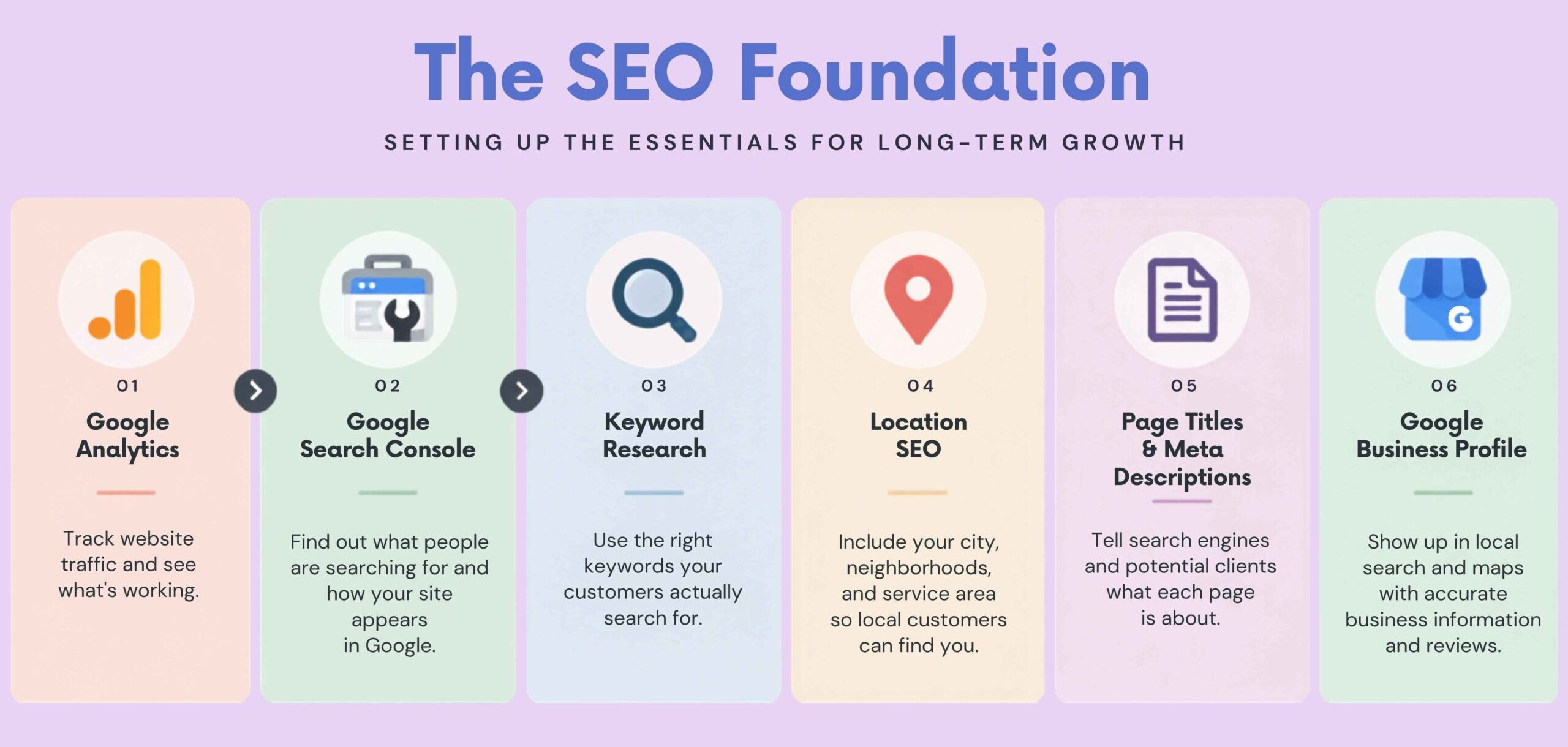
I rewrote the core pages to be location specific, using the actual language customers search for, not made up phrases. I fixed the header tags and rewrote the SEO titles and meta descriptions. That was the full scope, on a reasonable budget. We restructured what existed. We didn’t add new pages, and that’s a normal, honest scope for a lot of small businesses.
Two and a half years later, the site started ranking for new keywords, including location specific ones it had never shown up for before. That’s the foundation doing its job. But a foundation only works if somebody keeps building on it. Reviews, new service pages, fresh content. None of that happened for over two years.
Google Business Profile reviews were part of that gap. There weren’t any before we worked together, and reviews are one of the clearest signals Google uses to decide who shows up in local map results and in AI answers now. Land in the top three of a map search and you get clicks and clients. But it’s something you can’t fake, can’t outsource, and it takes consistent work.
If you’re managing your own SEO, my One-Page SEO Checklist is a good gut check for what to prioritize once the basics are in place, and my SEO Monitoring Tools Guide walks you through reading your own Search Console and Analytics data instead of guessing.
Does Google Punish Old Websites?
Not directly. There’s a myth going around that an untouched website gets penalized just for being old. That’s not technically true. Republishing the same content or changing a post date does nothing either.
Here’s what actually happens. Google looks for content that’s genuinely useful and first hand, not something anyone else could have written. If a site sits untouched for two years, it stops producing any of that. Most pages that lose ground don’t lose because they got worse. They lose because someone else got better.
Why 400 Pages Won’t Fix What’s Missing
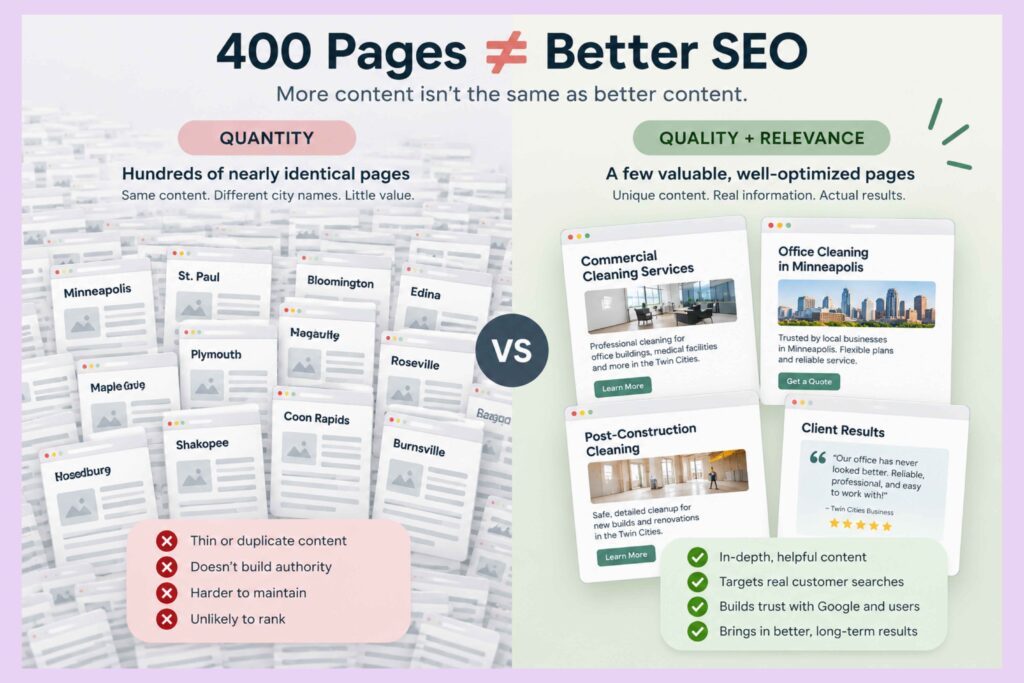
Recently, my former client told me she found a cheap SEO company that’s going to build her four hundred pages, including location specific pages. This tactic used to work five or six years ago. It doesn’t anymore, and Google is specific about why.
Google’s guide on optimizing your website for generative AI says directly that creating separate content for every possible way someone might search, in order to manipulate rankings or generative AI responses, violates its scaled content abuse spam policy.
It adds that high quantity doesn’t make a website higher quality or more relevant, and that its systems now understand what a page is about even without an exact keyword match.
There’s a second policy worth knowing here, called doorway abuse. This happens when pages are created to rank for similar searches and funnel visitors to a destination that would have been just as useful to visit directly.
Multiple location specific pages that all lead to the same place is a textbook example. And this year, Google clarified that these same spam policies apply to its generative AI responses too, so a mass page strategy isn’t a side door into AI search either.
Publishing hundreds of thin, near identical pages isn’t a one page problem. It changes what your website mostly is. You haven’t added four hundred pages to your business. You’ve diluted your entire site down to the average quality of those four hundred pages.
Some might rank for a while. But when it corrects, it doesn’t just take those pages down. It takes your whole site’s authority with it.
Three Red Flags to Watch For in an SEO Pitch
If an agency approaches you with any of these, slow down and ask questions.
1. Bulk location pages
If someone promises you hundreds of pages, ask what will actually be different about each one. Pages that just swap the city name risk getting flagged as duplicate content and unindexed. Location pages SEO only works when the copy is genuinely specific to that place.
2. Technical theater
There’s a whole cottage industry selling AI optimization files and heavy schema markup as the key to showing up in AI search. Google’s own guide busts that myth directly. Search doesn’t use those files, and you don’t need any special markup to appear in Google’s AI features.
Same goes for FAQ schema. Google added a deprecation notice this year, so the visible FAQ dropdown in search results is going away. It’s not the visibility lever it once was.
3. Directories and citations
Getting listed in two hundred directories sold as a growth package is a flag. Only the ones people actually search on matter, and plenty of the rest get marked as spam. When someone leads with directories, that usually means it’s the easiest thing to automate an invoice for.
Listen to the full episode for the complete breakdown of all three red flags, including exactly what to ask when you hear a pitch like this.
How to Evaluate Any SEO Provider
Google published new guidance on using third-party SEO tools, services, and advice in June of this year, and it’s genuinely useful if you’re trying to figure out whether someone is legit.
Nobody is Google approved
Google states plainly that it doesn’t evaluate third party services. If anyone tells you their method is approved or acceptable by Google, that’s a flag.
Watch for guarantees
An audit should give you a realistic estimate of improvement and the work involved. It should never guarantee you first place in search results. If it does, Google is telling you directly to walk away.
Ask what they’re actually doing
Good SEO advice either clearly labels itself as opinion based on data and experience, or backs itself up with official Google guidance. You’re allowed to ask, is this your opinion, or can you show me where Google says this.
Third party scores are not Google scores
Tools like Ubersuggest produce estimates, not numbers that come directly from Google. I use Ubersuggest and I like it, but I’m clear with clients that the difficulty score is an estimate, not gospel.
What I’d Change and What I Wouldn’t
I believe in foundations. A one time project is worth doing on its own, but make sure you own your Google Analytics and Search Console access from day one, not your web person. Ask what you’re supposed to do after a project ends, and if there’s no list, get one.
If you’re handling growth yourself, pick a couple of things and commit. Get reviews. Manage your Google Business Profile. Answer the questions your customers are actually asking, in blog form, on a schedule you can keep (once or twice a month, not AI generated filler to hit a number).
Check Search Console once a month, not more, and watch whether you’re showing up for more things than before. That’s the number I care about most, more than raw traffic. I wrote a whole checklist for what to watch after a site change, and the same numbers matter here too.
My skepticism here is about the language used to describe the pitch, not a verdict on the company. Four hundred pages might mean four hundred search terms and not four hundred literal pages, and I genuinely don’t know the scope. SEO is technical, results take months, and it’s easy to sell something that sounds great but never delivers.
A Foundation Is Not the Finish Line
I’m not against location pages. I believe in adding pages over time, but they have to be unique: a real point of view, first hand experience, a real story about a job you actually did for a person you actually served. I wrote about what actually makes a piece of content worth ranking in 2026, and the same standard applies here. Four hundred template city pages will never get you there.
My work is a slow burn. I don’t promise overnight results, and it’s an investment, but my clients always know exactly what they’re paying for and that their site keeps getting better, not just bigger. That compounds. Four hundred pages won’t. They might spike traffic for a while, but it costs you later when Google’s spam filters catch up.
One of my retainer clients hasn’t seen a big traffic jump this year, but her individual service pages, the ones that used to get no traffic at all, are finally getting found by the exact people looking for that specific service. That’s the difference between traffic and an actual appointment.
If you take one thing from this post, let it be this. A foundation is not the finish line. Somebody has to keep building. If it’s not going to be me, it has to be you.
Frequently Asked Questions
There is no single number, because SEO foundation work and ongoing growth are two different jobs. A foundation can start showing new keyword rankings and impressions within a few months, but real business results usually take continued work over a year or more.
No. Location pages SEO works fine when every page is genuinely unique, specific to that place, and adds real value. It becomes a problem when pages are duplicated with just a city name changed, which risks doorway abuse and scaled content abuse penalties.
Not directly. Google does not penalize a site simply for being old. The real issue is that an untouched site stops producing first hand, useful content, so it naturally falls behind competitors who keep publishing.
Watch for guarantees of first page rankings, claims of being Google approved, and pitches that lead with bulk pages, technical add-ons, or directory listings instead of quality content. Google’s own guidance says nobody is Google approved and no service can guarantee ranking results.
Yes. Reviews are one of the clearest signals Google uses to decide who shows up in local map results and in AI answers, and they cost nothing but consistent effort.
So how long does SEO take to work?
Long enough that the real answer is uncomfortable. A foundation can be built in weeks. Growth on top of that foundation takes ongoing, consistent work, month after month, for as long as you want the results to keep coming.
If you are ready to build that foundation the right way, my SEO Foundations package covers exactly what my client was missing: properly set up analytics, search console, and Business Profile, a real keyword strategy, and title and meta work that actually reflects your business. Not sure where you stand yet? Book a Baby Step call and we will map out three to five things you can start on right now, no pressure, just clarity.
And if you want to go it alone for a bit first, grab my SEO Monitoring Tools Guide so you can actually read your Google Search Console and Analytics data instead of guessing, and keep my One Page SEO Checklist nearby so you always know what to prioritize next.
Listen to the full episode for the complete story, and everything I’d tell any small business owner to watch for before hiring an SEO company.