Your Website Relaunch Checklist: How to Measure Success After You Go Live
Filed Under


You just launched your website. Or relaunched it. Either way, you’re refreshing your analytics every day wondering, is it working?
Here’s the thing. Most people are measuring the wrong things at the wrong time. And if you relaunched (meaning you already had a site and just rebuilt it), there’s a whole extra layer of traps to watch out for.
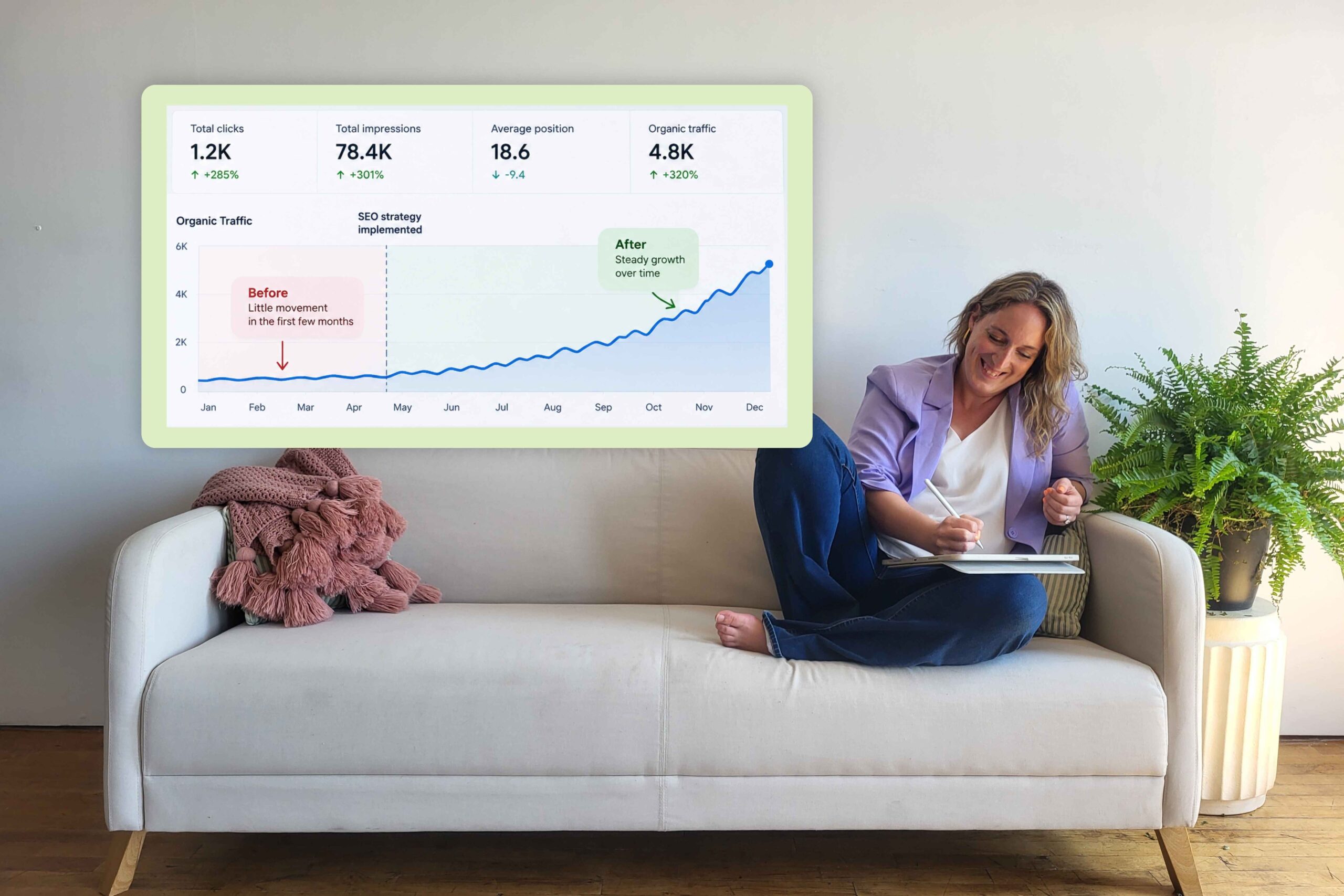
I’m pulling real data from my own clients in this post so you can see what actual growth looks like in the first few months. No vanity metrics, no fake timelines. Just what your website relaunch checklist should actually include when it comes to tracking.
The 3 Things People Obsess Over (That Don’t Matter Yet)
Let’s get this out of the way first. There are three numbers people check constantly after launch that mean almost nothing in the first 30 to 60 days.
1. Daily traffic.
In the first month, your site is still being discovered. Google is crawling it, learning it, deciding if you’re worth showing. Checking traffic every day right now is like weighing yourself every hour after starting a new workout routine. The data is too fresh to mean anything.
2. Domain authority.
If you’re using a tool like Ubersuggest and seeing a domain authority of one or two, that’s completely normal for a new site. One of my clients right now has a domain authority of one and is pulling in over 2,000 impressions a month. Domain authority is a lagging indicator. It tells you where you’ve been, not where you’re going.
3. Page one rankings.
The average page that ranks in the top 10 is over two years old. If you launched last Tuesday, you’re not going to rank on page one yet. That doesn’t mean something is wrong. It means SEO takes time, especially if you’re not targeting low-competition keywords.
Website Relaunch Checklist: The Traps to Watch Out For
Relaunching is different from launching fresh. There are specific landmines that catch people off guard, and your website relaunch checklist needs to account for all of them.
Expect a temporary traffic dip. If URLs changed, if pages got removed, if you restructured your site, Google has to relearn everything. Redirects help (I always set these up for my clients), but there will still be an adjustment period. That dip is not the new normal. It’s a transition.
A redesign won’t fix traffic on its own. I hear this one all the time. ‘My old site wasn’t getting traffic, so I got a new one.’ But if the reason you weren’t getting traffic was missing content, no SEO foundation, or targeting the wrong keywords, a prettier design won’t change that. A beautiful site with no structure is still invisible to search.
Old authority doesn’t carry over automatically. If your old site had been live for five or ten years, it had authority, backlinks, and indexed pages. A dramatic restructure resets some of that. The new site needs time to rebuild. Give it the same patience you gave the original.

The Feedback Trap (This One’s Important)
When you relaunch, you’re going to get feedback. A lot of it will come from people who love you. Your family, your friends, the coworker who thinks everything you do is amazing. They’ll say things like, ‘It’s beautiful, I love the colors, you should be so proud.
Those compliments feel great. But none of those people are your customers.
Your actual customer is asking one question: can this person solve my problem? And they’re making that decision in about three seconds.
Real feedback comes from real customer behavior. Are people landing on your site and sticking around? Are they bouncing immediately? What pages are they visiting? Where are they dropping off? Google Analytics tells you all of this. That’s what you should be studying.
What to Actually Track: Your SEO Keyword Ranking Tracker Breakdown
I call the first six months the momentum phase. You’re not converting at scale yet. You’re building the foundation that makes conversions possible. Here’s what a solid keyword ranking tracker should show you moving in the right direction.
Impressions
Before anyone clicks, Google Search has to show your site. Impressions climbing in Google Search Console means Google sees you. You want this number moving up month over month, even if clicks are still low. Impressions up while clicks stay flat just means your ranking position still needs work, and that’s a normal part of the process.
Keyword count
How many keywords is your site ranking for, even on page three or four? Growing from 10 ranked keywords to 60 to 150 over six months is meaningful progress, even if you’re not on page one for any of them yet.
Average position
You might start ranking for 50 keywords with an average position of 30. Over a few months, you want to see that number get lower (meaning you’re moving up). From 30 to 22 to 15 to 10. That’s the trajectory that matters.
Backlinks
Every time someone links to your site, Google takes it as a vote of confidence. Even going from 4 backlinks to 17 in six months is solid growth for a small business site that isn’t doing active link building.
AI referral traffic
This one is newer but it’s big. If you’re seeing traffic from ChatGPT, Perplexity, or other AI tools in your Google Analytics, that’s a strong signal your content is structured well. One of my clients landed her biggest client ever through ChatGPT within a couple months of her relaunch. The strategy for AI search is the same as regular SEO: clear structure, real content, answers to actual questions.
Client inquiries
One real inquiry from a stranger beats a hundred compliments from people who already know you. That’s the clearest signal your site is working.
Real Client Data: What SEO for Service Based Business Actually Looks Like
I track all of my clients through a dashboard called Tracker by PW Designs. Here’s what real, steady growth looks like for three of them.
Breathe Deep Bodywork (massage business, Maple Grove MN). Launched October 2025 with no previous website. In six months, clicks went from 92 to 166 (80% increase), impressions jumped from 779 to over 2,000 (158% increase), keyword count went from 60 to 151, and backlinks went from 4 to 17. She’s not going viral. She’s steadily building visibility in her local market and getting clients from Google without blogging.
Framed Eyewear (relaunch story). Went from a one-page site with almost no structure to a five-page site with real content and SEO foundation. From December 2025 to May 2026, clicks went from 9 to 154 (that’s roughly a 1,600% increase), impressions from 105 to 4,000, and keyword count from near zero to 352. That’s what happens when Google finally has enough to work with.
Ashley from Straighten Up Homes (professional organizer, California). Relaunched in early January 2026. Within a couple of months, she landed her biggest client ever, and that client found her through ChatGPT. Her site showed up because it’s structured well, answers real questions, and is clear about who she helps.
None of these are overnight results. All of them are the product of solid structure and patience. If you want to understand what tools I use to pull these numbers together each month, the SEO Monitoring Tools Guide breaks it all down.
How to Track Your Own SEO Progress (DIY Version)
You don’t need a fancy dashboard to track your site. You need three tools and a simple habit.
Google Search Console (free). Check it monthly. Write down your impressions, clicks, average position, and keyword count. Keep it in a spreadsheet so you can see the trend over time.
Google Analytics (free). Shows you how people are finding your site, what pages they land on, how long they stay, and whether they’re clicking your call to action. Track where traffic is coming from so you’re not just counting direct visits.
Ubersuggest. Good for tracking domain authority, backlinks, and organic keyword rankings at a quick glance.
If you want a starting point for what to look at each month, grab the One-Page SEO Checklist. It’s free and gives you a clear picture of whether your foundation is solid before you stress about traffic numbers.
The 6-Month SEO Timeline: What to Expect
Months 1-2
Google is finding you. Impressions start to trickle in. Traffic is low, and that’s okay. Make sure your site is submitted to Google Search Console and technically sound. Check your analytics monthly at most. You don’t have enough data yet to make decisions.
Months 3-4
Impressions are climbing. You’re starting to rank for more keywords, even if it’s pages 2 through 5. You might see your first organic leads come through. This is where people get impatient and start questioning everything. Don’t. This is where compounding starts.
Months 4-6
This is where it starts to feel real. Clicks are climbing. You’re appearing in more search terms. If you’ve been consistent with long-form content, those pieces start to gain traction. SEO is a compounding investment. Every piece of content, every backlink, every month you’ve been live builds on itself.
If you want to skip the guesswork and have someone build and track this with you, here’s how I work with clients on SEO.
Your Consolidated Website Relaunch Checklist
- Stop checking daily traffic in the first 30 to 60 days. It doesn’t mean what you think it means.
- If you relaunched, expect a temporary traffic dip. Set up redirects, give it time.
- Track impressions before traffic. Impressions growing month over month means Google is seeing you.
- Watch your keyword count climb. Going from 10 to 150 ranked keywords in six months is real progress.
- One client inquiry from organic search beats a hundred compliments from friends.
- Keep a simple monthly spreadsheet. You can’t improve what you don’t measure.
- Long-form content is what compounds your results after launch. Don’t stop at the foundation.
FAQ: Measuring Website Relaunch Success
A Website Launch Is a Starting Line, Not a Finish Line
A relaunch isn’t a magic reset button. It’s a new foundation. The first 30 days are not when you measure success. Success is measured at six months, at twelve months, in the trajectory of steady growth.
Appreciate the compliments from people who love you. Then put your energy into the data. Look at impressions before you look at traffic. Watch your keyword count grow before you worry about page one. Get curious about what actual visitors are doing on your site.
The sites that win are built on solid structure, clear content, and patience. Every client I shared above is proof of that.
Want help with the foundation piece? I do one-hour SEO coaching calls where we look at your specific site and talk through what’s working and what needs attention.